Flow Trough Test

    The flow trough test (Bartos, Sonebi, and Tamimi 2002) is used to measure the workability of highly flowable concretes. It was originally developed for measuring repair concretes.
    The test apparatus consists of a 230 mm wide, 1000 mm long horizontal steel trough. Approximately 6 liters of concrete is placed in a conical hopper and allowed to fall from the hopper onto one end of the trough. The time required for concrete to flow a certain distance (typically 750 mm) down the trough is recorded. The test is conducted three times immediately after mixing and another three times thirty minutes after mixing. The set of tests is conducted at thirty minutes in order to characterize the workability of the concrete at the time of placement. The concrete is agitated every five minutes in the thirty minutes between the initial and final sets of tests.
Advantages:
• The test method is simple and inexpensive.
• The results are a function of the time required for the concrete to flow both out of the cone and down the trough.
Disadvantages:
• The test is only appropriate for highly flowable concrete mixtures.
• The test is not standardized and not widely used.

Vibropenetrator

      The Vibropenetrator was Developed by Komlos in 1964 the Vibropenetratoras is a penetration test which measures the behavior of vibrated concrete. The device consists of a standard 20 cm cube mold mounted on a vibrating table. Concrete is placed in the mold and compacted with the assistance of the vibrating table. A rod, which is guided by a sleeve mounted to the cube mold, is placed on top of the concrete. The vibrating table is started and the time for the rod to penetrate a certain depth into the concrete is measured as an indication of workability. A ring on the rod touches the top of the sleeve to indicate the end point of the test. Komlos performed the test on moderate to highly workability concretes with water/cement ratios ranging from 0.38 to 0.90.
        The Vibropenetrator test has the advantage of being a dynamic test that adds energy to the concrete. The results of the test are a function of not just the concrete properties, but also the nature of the applied vibration. Large coarse aggregates could interfere with the descent of the rod and distort test results.

Advantages:
• The Vibropenetrator test is a dynamic test that measures the behavior of vibrated concrete.
• The test is simple to perform and provides a direct result.
Disadvantages:
• Large coarse aggregates could distort test results by interfering with the descent of the penetrating rod.
• Although the test has been performed on a wide range of concrete workability, highly flowable concrete with a water cement ratio near 0.90 would likely be difficult to test with precision.
• The test requires a vibrator and electricity and is not as simple as other single-point field tests.

Flow Table Test (DIN Flow Table)

      The flow table test (Tattersall 1991; Bartos 1992; Wong et al. 2000; Bartos, Sonebi, and Tamimi 2002) measures the horizontal spread of a concrete cone specimen after being subjected to jolting. Multiple versions of the test have been proposed since its original introduction in Germany in the 1930s. The test was added to the British Standards in 1983 in response to the increase use of highly fluid concretes. The test is sometime referred to as the DIN flow table, in
reference to its inclusion in German standard DIN 1048. The test is currently standardized in the Europe as EN 12350-5.
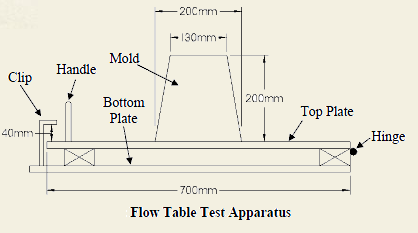
       The apparatus consists of a 700 mm square wooden top plate lined with a thin metal sheet, as shown in Figure. The plate is hinged on one end to a base, while on the other end, clips allow the plate to be lifted a vertical distance of 40 mm. Etched into the metal sheet are two perpendicular lines that cross in the center of the plate and a 200 mm circle concentric with the center of the plate. The frustum of a cone used to mold the concrete is shorter than the slump cone, with a top diameter of 130 mm and with a bottom diameter and height of 200 mm.Flow Table Test
      To perform the test, the cone mold is placed in the center of the plate and filled in two layers, each of which is compacted with a tamping rod. The plate is lifted with the attached handle a distance of 40 mm and then dropped a total of 15 times. The horizontal spread of the concrete is measured. Resistance to segregation can be assessed qualitatively: in concrete mixes that are susceptible to segregation, the paste will tend separate from the coarse aggregate around the perimeter of the concrete mass.
     The test is applicable to a wide range of concrete workability, and is especially appropriate for highly fluid mixes that exhibit a collapsed slump. The results of the test can be correlated to slump, although it has been suggested that the initial horizontal spread, prior to jolting, correlates better to slump (Juvas 1994). Despite its simplicity, the test apparatus is large and must be placed on firm, level ground. The jolting of the concrete does not accurately simulate field  practices and cannot easily be treated analytically. In fact, the further the concrete spreads, the thinner the layer of concrete becomes and the less this thin layer represents the bulk properties of the concrete. Research has suggested that spread measurements for different concrete mixtures  converge with an increasing number of drops of the top plate (Tattersall 1991).
Advantages:
• The test is simple and can be used in the field.
• The test quickly provides a direct result.
• The test is dynamic, making it especially appropriate for highly thixotropic concrete mixtures.
Disadvantages:
• The test procedure does not represent actual placement conditions—concrete is typically  vibrated, not jolted.
• The test results tend to converge as the number of drops is increased. Near the end of the  test, the properties of the thin layer of concrete do reflect the bulk properties of the  concrete.
• The results are not given in terms of fundamental units. An analytical treatment of the  test would be difficult.

Vibratory Flow Meter

           Flow of concrete under simulated field conditions is measured by the vibratory flow meter (Szecsy 1997). The is a   similar test to the LCL flow test, Angles flow box, and the vibrating slope apparatus.
           The test apparatus, shown in Figure 1, consists of a 48 inch long, 6 inch wide, and 6 inch tall box. A vertical gate approximately one-fourth of the length from one end of the box separates the box into two sections. To conduct the test, concrete is placed in the shorter portion of the box. The gate is opened to a height of three inches and a vibrator is inserted into the concrete in the shorter portion of the box. After thirty seconds, the vibrator is removed and the distance the concrete has traveled down the box is recorded.

Vibratory FLow Meter

      In testing conducted to compare the results of the vibratory flow meter to rheological parameters, Szecsy (1997) showed that vibratory flow and plastic viscosity exhibited a general relationship; however, the scatter of the data was large. Further, the vibratory flow meter was not always able to detect changes in mixture proportions. For instance, the vibrator flow meter was able to detect
changes in sand content for concrete mixtures containing river gravel, but not for mixtures with a crushed limestone aggregate. The vibratory flow meter was able to detect changes in water/cement ratio and high-range water reducing admixture dosage.
Advantages:
• The test method is simple and provides a direct result.
• The test apparatus consist of readily available equipment and materials.
Disadvantages:
• Preliminary test results indicate that the device is not effective in distinguishing between changes in mixture proportions.
• The test results are dependent on the type of vibrator used. If an internal poker vibrator is used, the effect of vibration will change as concrete flows further away from the location of the vibrator.
• The test results are not given in terms of yield stress or plastic viscosity.

Vertical Pipe Apparatus

       The vertical pipe apparatus (Tattersall and Baker 1989; Banfill, Yongmo, and Domone 1999) is a laboratory device which measures the effects of vibration on fresh concrete.
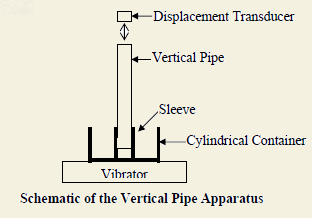
     The device, which is depicted in Figure 1, consists of a 100 mm diameter, 700 mm long vertical pipe mounted above a metal cylindrical container that is attached to a vibrator. A sliding sleeve holds concrete in the pipe initially. A block attached to the container ensures that when the sleeve is lifted, concrete flows horizontally out of the pipe and is not blocked by concrete already in the cylindrical container. The block is 70 mm tall and the gap between the block and the pipe is 60 mm. To begin the test, the vibrator is started and the sleeve is lifted to allow concrete to flow out of the pipe. An ultrasonic displacement transducer above the pipe of concrete measures the height of the concrete in the pipe versus time. In older versions of the test, a tape measure was used to measure this distance.

Vertical Pipe Apparatus

    The test is based on the principle that concrete behaves as a Newtonian fluid when subjected to vibration. The rate of flow of a Newtonian fluid in a vertical pipe is a function of the head, H, as shown in Equation [1], where b is the constant of proportionality expressing fluidity.equation      The vibrator must be a simple wave-form vibrator with independent control of frequency and velocity. An inexpensive eccentric type or a common commercial vibrator would not allow the study of the effects of different vibration parameters on concrete.


Advantages:
• The vertical pipe apparatus is a dynamic test that provides valuable information on the flow of concrete under vibration.
• By changing the vibration parameters, the test can be used to determine values related to yield stress and plastic viscosity.
Disadvantages:
• The test is expensive and may not be appropriate for field use. The test does not provide a direct result.
• The 60 mm size of the opening below the pipe is too small for most aggregate sizes.
• For highly flowable concretes, the concrete will quickly flow out of the pipe without the assistance of vibration.

Thaulow Tester

       Thaulow concrete tester (Powers 1968; Scanlon 1994; Wong et al. 2000) is a test similar to the Vebe consistometer and the Powers remolding test. Its specialty  is, it allows the measurement of concretes with higher workability.
       The apparatus consists of a 10 liter cylinder of smaller diameter than the containers used in the Vebe consistometer and the Powers remolding test. The cylinder is attached to a drop table. A handle is mounted with pins at the top of the cylinder. A mark on the cylinder at 5 liters assists in determining the end of the test. Concrete is placed in the cylinder using the standard slump cone. For concretes with moderate workability, the handle is allowed to fall from its vertical position and strike opposite sides of the container until the concrete remolds to the 5 liter mark on the container. For low slump concretes, the number of drops of the table required to remold the sample to the 5 liter mark is recorded.
        The Thaulow concrete tester is applicable mainly to low slump concrete. ACI Committee 211 (2002) has recommended using the Thaulow concrete tester for concretes that are too dry to be measured with the slump cone.

Advantages:
• The Thaulow concrete tester is a dynamic test method.
• The handle attached to the cylinder allows for the measurement of concretes with higher workability than can be measured with the Vebe consistometer and the Powers remolding test.
• Test results are obtained directly.

Disadvantages:
• The drop table must be mounted on an object of sufficient mass to absorb vibrations created by the drop table. Accordingly, the device is likely to be too large and bulky for field use.
• No analytical treatment or experimental testing of the test device has been performed to relate the test results to yield stress and/or plastic viscosity.

PENETRATION RESISTANCE OR WINDSOR PROBE TEST

            The principle of  windsor probe test is like the rebound hammer test.It is a hardness tester, and its inventors’ claim that the penetration of the probe reflects the precise compressive strength in a localized area is not strictly true. However, the probe penetration does relate to some property of the concrete below the surface, and, within limits, it has been possible to develop empirical correlations between strength properties and the penetration of the probe.

EQUIPMENTS
      The Windsor probe consists of a powder-actuated gun or driver, hardened alloy steel probes, loaded cartridges, a depth gauge for measuring the penetration of probes, and other related equipment. As the device looks like a firearm it may be necessary to obtain official approval for its use in some countries. The probes have a tip diameter of 6.3 mm, a length of 79.5 mm, and a conical point. Probes of 7.9 mm diameter are also available for the testing of concrete made with lightweight aggregates. The rear of the probe is threaded and screws into a probe driving head, which is 12.7 mm in diameter and fits snugly into the bore of the driver.
      The probe is driven into the concrete by the firing of a precision powder charge that develops energy of 79.5 m kg. For the testing of relatively low strength concrete, the power level can be reduced by pushing the driver head further into the barrel.

PROCEDURE
     The area to be tested must have a brush finish or a smooth surface. To test structures with coarse finishes, the surface first must be ground smooth in the area of the test. Briefly, the powder-actuated driver is used to drive a probe into the concrete. If flat surfaces are to be tested a suitable locating template to provide 178 mm equilateral triangular pattern is used, and three probes are driven into the concrete, one at each corner. A depth gauge measures the exposed lengths of the individual probes. The manufacturer also supplies a mechanical averaging device for measuring the average exposed length of the three probes fired in a triangular pattern. The mechanical averaging device consists of two triangular plates. The reference plate with three legs slips over the three probes and rests on the surface of the concrete. The other triangular plate rests against the tops of the three probes. The distance between the two plates, giving the mechanical average of exposed lengths of the three probes, is measured by a depth gauge inserted through a hole in the centre of the top plate. For testing  structures with curved surfaces, three probes are driven individually using the single probelocating  template. In either case, the measured average value of exposed probe length may  then be used to estimate the compressive strength of concrete by means of appropriate
correlation data.
       The manufacturer of the Windsor probe test system has published tables relating the  exposed length of the probe with the compressive strength of the concrete. For each exposed  length value, different values for compressive strength are given, depending on the hardness  of the aggregate as measured by the Mohs' scale of hardness. The tables provided by the  manufacturer are based on empirical relationships established in his laboratory. However, investigations carried out by Gaynor, Arni, Mallotra, and several others indicate that the  manufacturer's tables do not always give satisfactory results. Sometimes they considerably  overestimate the actual strength and in other instances they underestimate the strength.
     It is, therefore, imperative for each user of the probe to correlate probe test results with the type of concrete being used. Although the penetration resistance technique has been standardized the standard does not provide a procedure for developing a correlation. A practical procedure for developing such a relationship is outlined below.

  1. Prepare a number of 150 mm × 300 mm cylinders, or 150 mm3 cubes, and companion 600 mm × 600 mm × 200 mm concrete slabs covering a strength range that is to be encountered on a job site. Use the same cement and the same type and size of aggregates as those to be used on the job. Cure the specimens under standard moist curing conditions, keeping the curing period the same as the specified control age in the field.

  2. Test three specimens in compression at the age specified, using standard testing procedure. Then fire three probes into the top surface of the slab at least 150 mm apart and at least 150 mm in from the edges. If any of the three probes fails to properly penetrate the slab, remove it and fire another. Make sure that at least three valid probe results are available. Measure the exposed probe lengths and average the three results.

  3. Repeat the above procedure for all test specimens.

  4. Plot the exposed probe length against the compressive strength, and fit a curve or line by the method of least squares. The 95% confidence limits for individual results may also be drawn on the graph. These limits will describe the interval within which the probability of a test result falling is 95%.

   A typical correlation curve is shown in Fig. 7.1, together with the 95 confidence limits for individual values. The correlation published by several investigators for concrete made with limestone gravel, chert, and traprock aggregates are shown in Fig. 7.2. Note that different relationships have been obtained for concrete with aggregates having similar Mohs' hardness numbers.

Free Orifice Test (Orimet Test)

      The free orifice test or Orimet Test (Bartos 1992; Bartos 1994; Wong et al. 2000; Bartos, Sonebi, and Tamimi 2002) measures the time required for concrete to flow through a vertical tube and out a smaller diameter orifice at the bottom of the tube.  Originally developed by Bartos (in 1978) this test is used as a rapid field test to measure the workability of concretes that were too flowable to be measured with the slump test.
      The apparatus consists of a 600 mm long, 100 mm diameter pipe held in a vertical position with a tripod. An interchangeable orifice, which narrows the diameter of the pipe, is attached to the bottom of the pipe. The standard orifice size of 80 mm is appropriate for concrete mixes with a maximum aggregate size of 20 mm. Other typical orifice sizes are 70 mm and 90 mm. To perform the test, concrete is placed in the pipe but not compacted. A door on the bottom of the orifice is opened and the time for the concrete to flow completely out of the pipe is measured.
        For normal, flowable concrete mixes, Bartos (1992) reported typical flow times of 1.5 to 6 seconds; however, more cohesive concretes can have flow times greater than 60 seconds. If a mix is highly susceptible to segregation, coarse aggregates tend to accumulate near the orifice and slow or completely block flow. A non-continuous discharge can suggest a concrete mixture’s susceptibility to segregation. The standard test requires approximately 7.5 liters of concrete and should be repeated at least 2-3 times. In some cases, the results of the free orifice test have been correlated to slump (Wong et al. 2000).
         The free orifice test is simple and easily portable; however, it requires modifications in order to measure a wider range of concrete mixtures. For concretes with low slump, a vibrator could be attached externally to the pipe in order to promote flow. Different size aggregates require different size orifices, a fact that complicates the comparison of test data. The main source of error is operator error in measuring the exact start and stop times for the test. Wong et al. (2000) made several recommendations for modifying the free orifice device in order to obtain additional information about the concrete mix. The time for the concrete to flow out of the tube could be used in addition to slump in order to characterize workability better.
          Alternatively, multiple shear rates could be achieved by placing surcharge weights on the concrete. While this idea of using multiple shear rates has been suggested, it is unknown whether this idea has been attempted. In a test of anti-washout mixtures conducted by Bartos (1994), the free orifice device clearly showed changes in the cohesiveness of the concrete mixtures. Further, the free orifice test successfully showed sensitivity to changes in fine aggregate content. By contrast, when the flow table test was performed on the same concrete mixtures, the associated changes in workability due to changes in fine aggregate content were not detected.
Advantages:
• The test is inexpensive and simple to use. Even if the apparatus is not placed on level ground, an accurate result can still be obtained.
• The test quickly provides a direct result.
• The test represents a good simulation of actual placing conditions for highly flowable concretes.
Disadvantages:
• The test method is only appropriate for highly flowable and self-compacting concretes.
• Although the test provides a good indication of cohesiveness, the results are not expressed in terms of fundamental units.

U-Box Test

       Like L-box test, U-box test measures the filling ability of self-compacting concrete. The U-box test originally developed in Japan and is sometimes referred to as the box-shaped test. Like other workability tests for self-compacting concrete, the U-box test is also applicable to highly flowable concretes and underwater concretes.

APPARATUS
        As shown in Figure the apparatus consists of a  U-shaped box. Concrete is placed in the left side of the box. An alternative version of the apparatus features a flat bottom instead of a curved bottom. Ideally, the box should be made of clear plastic to permit the observation of the concrete in the box. To start the test, the door dividing the two halves of the box is opened and concrete is allowed to flow from the left half of the box into the right half. Reinforcing bars are placed at the location of the door. Although the spacing of the bars is adjustable, the most common arrangement is 13 mm diameter bars with a clear spacing of 35 mm. The time from the opening of the door until the concrete ceases to flow is recorded. The height of the concrete in each side of the box is measured. A truly self-leveling fluid will rise to the same height on each side of the box. Concrete with good filling ability should reach a height of at least 30 cm on the right side of the box. In some versions of the test, a surcharge load is applied to the concrete on the left side of the box. This surcharge load is unnecessary for self-compacting concrete and is generally not used.
       With both the L-box and U-box tests, it is unknown what significance the effect of friction between the concrete and the walls has on the test results.

U Box Test

L-Box Test

      The L-box test is used to  measure the filling and passing ability of self-compacting concrete.This test was originally developed in Japan for underwater concrete, the test is also applicable for highly flowable concrete. 
        The apparatus consists of an L-shaped box, shown in Figure below. Concrete is initially placed in the vertical portion of the box, which measures 600 mm in height and 100 mm by 200 mm in section. A door between the vertical or horizontal portions of the box is opened and the concrete is allowed to flow through a line of vertical reinforcing bars and into the 700 mm long, 200 mm wide, and 150 mm tall horizontal portion of the box. In the most common arrangement of reinforcing bars, three 12 mm bars are spaced with a clear spacing of 35 mm. Generally, the spacing of the reinforcing bars should be three times the maximum aggregate size. It should be noted that various dimensions for the L-box have been used and no one set of dimensions is considered official; however, the dimensions described above seem to be the most common.

L Box Test

     The time for concrete to reach points 20 cm (T20) and 40 cm (T40) down the horizontal portion of the box is recorded. After the concrete comes to rest in the apparatus, the heights of the concrete at the end of the horizontal portion, H2, and in the vertical section, H1, are measured. The blocking ratio, H2/H1, for most tests should be 0.80 to 0.85. If the concrete being tested is truly self-leveling, like water, the value of the blocking ratio will be unity. Segregation resistance can be evaluated visually. A concrete sample with coarse aggregate particles that reach the far end of the horizontal part of the box exhibits good resistance to segregation. The L-box can be disassembled after the concrete has hardened. By cutting out samples of the hardened concrete, additional information about the concrete’s resistance to segregation can be determined, as shown by Tanaka et al. (1993).
        While the test does give valuable information about filling and passing ability, and to a lesser extent, segregation resistance, the test is not as simple as the slump flow test. Since there are no standardized dimensions, results from different test apparatuses cannot be compared directly.

 L-Box Test

Direct Shear Test of Soil

     The direct shear test used for soil (Powers 1968) can be performed with fresh concrete to assess the cohesive strength of a concrete mixture. The results of the test are given in terms of soil mechanics parameters, not in terms of yield stress and plastic viscosity.
      The device, as described by Powers (1968), consists of a ring shaped container filled with compacted concrete. The lower half of the device is held in a fixed position while the upper half of the device is rotated slowly, resulting in a maximum shear stress on the plane between the two halves of the container. A vertical load can be applied to the concrete during the test. The test measures the angle of rotation of the upper container and the corresponding torque required to turn the container.
       A typical plot of torque versus relative displacement shows an initial linear increase in torque up to a maximum value and then a decline followed by a gradual leveling off of the curve. The maximum stress is considered the “static friction” and the stress after the plot has leveled off is considered the “sliding friction.” The linear relationship between static friction and normal stress allows the calculation of the angle of internal friction.
Advantages: • The test essentially determines the yield stress of the concrete.
• The test provides additional information, namely the angle of internal friction, not available from most conventional tests.
Disadvantages: • The results of the test are not described in terms of shear stress and shear rate. The use of the direct shear test predates the establishment of concrete as a Bingham material. The additional information provided by the test is not necessarily useful.
• The test does not provide a measure of plastic viscosity.
• The test is strictly a laboratory device.

PERMEABILITY TEST

       Permeability of concrete is important when dealing with durability of concrete particularly in concrete used for water retaining structures or watertight sub-structures.Structures exposed to harsh environmental conditions also require low porosity as well as permeability. Such adverse elements can result in degradation of reinforced concrete, for example, corrosion of steel leading to an increase in the volume of the steel, cracking and eventual spalling of the concrete. Permeability tests measure the ease with which liquids, ions and gases can penetrate into the concrete. In situ tests are available for assessing the ease with which water, gas and deleterious matter such as chloride ions can penetrate into the concrete.

PROCEDURE
     A comprehensive review of the wide range of test methods is given in the Concrete Society Technical Report No. 31. Two of the most widely established methods are the initial surface absorption test (ISAT) and the modified Figg air permeability test. The former measures the ease of water penetration into the surface layer of the concrete while the latter can be used to determine the rate of water as well as air penetration into the surface layer of the concrete which is also called the covercrete. Another newly developed technique uses modification of the laboratory test to determine chloride ion permeability. All the site tests emphasize the measurement of permeability of the outer layer of concrete as this layer is viewed as most important for the durability of concrete.

EQUIPMENTS

1. Initial surface absorption test
      Details of the ISAT is given in BS 1881:Part 5 which measures the surface water absorption. In this method, a cup with a minimum surface area of 5000 mm2 is sealed to the concrete surface and filled with water. The rate at which water is absorbed into the concrete under a pressure head of 200 mm is measured by movement along a capillary tube attached to the cup. When water comes into contact with dry concrete it is absorbed by capillary action initially at a high rate but at a decreasing rate as the water filled length of the capillary increases. This is the basis of initial surface absorption, which is defined as the rate of water flow into concrete per unit area at a stated interval from the start of test at a constant applied head at room temperature.

2. Modified Figg permeability Test
      The modified Figg permeability test can be used to determine the air or wate permeability of the surface layer of the concrete. In both the air and water permeability test a hole of 10 mm diameter is drilled 40 mm deep normal to the concrete surface. A plug is inserted into this hole to form an airtight cavity in the concrete. In the air permeability test, the pressure in the cavity is reduced to –55 kPa using a hand operated vacuum pump and the pump is isolated. The time for the air to permeate through the concrete to increase the cavity pressure to –50 kPa is noted and taken as the measure of the air permeability of the concrete. Water permeability is measured at a head of 100 mm with a very fine canula passing through a hypodermic needle to touch the base of the cavity. A two-way connector is used to connect this to a syringe and to a horizontal capillary tube set 100 mm above the base of the cavity. Water is injected through the syringe to replace all the air and after one minute the syringe isolated with a water meniscus in a suitable position. The time for the meniscus to move 50 mm is taken as a measure of the water permeability of the concrete.

3. In situ rapid chloride ion permeability test
     This method was originally designed for laboratory application but has been modified for in situ use. The procedure for the laboratory test is given in AASHTO T277 and ASTM C1202. The technique is based on the principle that charged ions, such as chloride (Cl- ), will accelerate in an electric field towards the pole of opposite charge. The ions will reach terminal velocity when the frictional resistance of the surrounding media reaches equilibrium with the accelerating force. This is the basis of “electrophoresis”, which is utilized in many chemical and biological studies.
      A DC power supply is used to apply a constant voltage between the copper screen and the steel reinforcement. The total current flowing between the mesh and the reinforcing bar over a period of six hours is then measured. The total electric charge (in coulombs) is computed and can be related to the chloride ion permeability of the concrete.

APPLICATIONS
       The methods described do not measure permeability directly but produce a ‘permeability index’, which is related closely to the method of measurement. In general, the test method used should be selected as appropriate for the permeation mechanism relevant to the performance requirements of the concrete being studied. Various permeation mechanisms exist depending on the permeation medium, which include absorption and capillary effects, pressure differential permeability and ionic and gas diffusion.
        Most of these methods measure the permeability or porosity of the surface layer of concrete and not the intrinsic permeability of the core of the concrete.  The covercrete has been known to significantly affect the concrete durability since deterioration such as carbonation and leaching starts from the concrete surface. This layer thus provides the first defense against any degradation.

RANGE AND LIMITATIONS
      For the ISAT, tests on oven dried specimens give reasonably consistent results but in other cases results are less reliable. This may prove to be a problem with in situ concrete.
      Particular difficulties have also been encountered with in situ use in achieving a watertight fixing. The test has been found to be very sensitive to changes in quality and to correlate with observed weathering behaviour. The main application is as a quality control test for precast units but application to durability assessment of in situ concrete is growing.

Settlement Column Segregation Test

      The settlement column segregation test (Bartos, Sonebi, and Tamimi 2002) measures the degree of segregation that occurs in a concrete subjected to a standard settlement period and a standard amount of jolting. The test method is primarily intended for highly fluid concrete mixtures.
      The test apparatus consists of a tall, rectangular box mounted on top of a standard mortar drop table. The column, depicted in Figure 16, is 500 mm tall and has cross sectional dimensions of 100 mm by 150 mm. Three doors on opposing sides of the box allow sections of concrete to be removed at the conclusion of the test. To begin the test, concrete is placed in the column and allowed to stand for one minute. The concrete is subsequently jolted 20 times in one minute using the drop table and then allowed to stand for an additional five minutes. The top door is then opened and the concrete behind the door is removed and saved. The concrete behind the middle door is discarded while the concrete behind the bottom door is saved. The samples from the top and the bottom of the column are individually washed through a 5 mm sieve to leave only the coarse aggregate. The segregation ratio is then calculated as ratio of the mass of coarse aggregate in the top sample to the mass of coarse aggregate in the bottom sample. The lower this ratio is, the greater the susceptibility to segregation will be.

Settlement Column Segregation Test

Advantages:
• The test attempts to simulate actual placement conditions.
• The test method is simple and does not require expensive equipment.
Disadvantages:
• The test is time consuming and is not practical for use in the field.
• The repeatability of test results decreases as segregation increases.

LCL Flow Test

      The LCL flow test (Bartos 1992; Ferraris 1999; Bartos, Sonebi and Tamimi 2002) is very similar to the Angles flow box test. The test is suitable for concretes with low and moderate workability and is not appropriate for concretes with very low or very high workability.
       The device consists of a 150 mm by 600 mm rectangular box with a height of 150 mm. An external vibrator is attached to one end. A triangular wedge holds uncompacted concrete in the opposite end of the box. Rubber supports beneath the box isolate the box and absorb vibrations.
       To start the test, the wedge is removed and the vibrator is started. The time for concrete to spread to the other end of the box and fill to a line marked on the side of the box is measured. The results of the LCL flow test are related to plastic viscosity. Further, yield stress could be determined by slowly increasing the amplitude of vibration until the concrete begins to flow. Although the test provides a direct and usable result, the device must be calibrated using a standard aggregate and a standard mix design in order to interpret the results further. The difficulty in determining the endpoint of the test reduces the precision of the test results. Two sizes of the device exist: one for normal concrete and another for mortars and concretes with maximum aggregate size less than 12.5 mm. The larger device requires 35 liters of concrete.
Advantages:
• The LCL flow test is a dynamic test, capable of measuring values related to both yield stress and plastic viscosity.
• The test partially represents actual field conditions.
• A direct result is quickly obtained.
Disadvantages:
• The test is more expensive and complicated than the slump test and requires electricity, thus reducing the likelihood it would be used in the field.
• Although the test does measure values related to yield stress and plastic viscosity, the values are not determined in fundamental units.
• The precise end point of the test can be difficult to determine.

Delivery-Chute Depth Meter

      The delivery-chute depth meter (US patent 4,578,989; Wong et al. 2000) is similar to the delivery-chute torque meter in that it measures the consistency of concrete as it exits a concrete mixing truck.
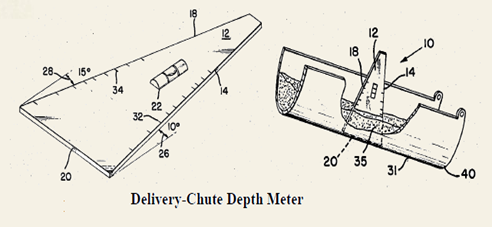
      The device is a triangular plate with an attached level, as shown in Figure 8. The angles at the base of the triangular plate are used along with the attached level to set the discharge chute to predefined angles. Concrete is allowed to flow down the discharge chute until it begins to fall off the end of the discharge chute. At that point, concrete flow is stopped and the device is inserted into the concrete. The height of the concrete in the chute, as measured on the triangular plate, is related to slump.
        The device must be calibrated for each concrete mixture tested. For a given concrete mix, the water content is systematically altered. For each water content, the slump and the depth of flow in the delivery chute are recorded in order to develop points on the device. Given that each separate concrete mixture must be calibrated separately, the device is best suited for jobs where a large quantity of one concrete mixture is being placed.

Delivery Chute Depth Meter

Advantages:
• The device allows workability to be judged quickly before any concrete exits the end of the delivery chute.
• The device is simple and inexpensive.
Disadvantages:
• The device must be calibrated for each concrete mixture.
• Any variations in concrete height along the length of the delivery chute could distort readings.

Moving Sphere Viscometer

      The moving sphere viscometer (Powers 1968; Wong et al. 2000) uses the principle of Stoke’s law to measure the viscosity of concrete. Falling object and drawn object viscometers have been used widely in measuring the viscosity of other materials. A similar test device, the turning tube viscometer, is used for pastes.
      To perform the test, concrete is placed in a rigid container, which can be attached to a vibrator in order to measure the concrete’s behavior under vibration. A steel sphere is then either pushed or pulled through the concrete. The test can be conducted either by applying a constant force to the sphere and recording the location of the sphere in the concrete versus time or by pushing or pulling the sphere through the concrete at a fixed rate and measuring the force required to move the ball. Using Stoke’s law, the viscosity of the concrete is then calculated as a function of the velocity of the sphere and the force required moving the sphere. Correction factors must be applied to account for assumptions made with regard to Stoke’s law. Wong et al. (2000) recently explored the possibility of developing a moving object viscometer for use with low slump concretes. The researchers encountered difficulty in determining a constant, steady state value of force required to pull a sphere through concrete. Although the researchers did not recommend such a moving object viscometer for use with low-slump concretes, they did suggest a conceptual field system.
Advantages:
• The physics of the test are well known, allowing viscosity to be measured.
• The test can measure the effect of vibration on viscosity.
Disadvantages:
• The sphere should be significantly larger than the maximum aggregate size. As a result, the concrete sample must be quite large in order to accommodate typical aggregate sizes.
• Although a conceptual field device has been proposed, the test method would likely be limited mainly to the laboratory. The test is more expensive and complex than most other single-point tests
• The test does not provide a direct result. The velocity of the sphere and the force applied to the sphere must be measured and used in an equation to calculate viscosity. Additionally, correction factors must be applied.
• While the test does provide a measure of plastic viscosity, it does not provide a direct measure of yield stress.

Powers Remolding Test

      The Powers remolding test (Powers 1968; Scanlon 1994; Wong et al. 2000) is similar to the Vebe consistometer. The test was develop by Powers and first presented in 1932. The test has been standardized by the US Army Corp of Engineers as CRD C6-74.
       The test apparatus consists of a 12 inch diameter cylindrical mold mounted on a standard drop table, described in ASTM C124 (which was withdrawn in 1973). A separate 8 ¼ inch diameter ring is attached at the top of the cylinder, as shown in Figure below. The concrete sample is compacted in the standard slump cone inside of the inner ring. Like the Vebe consistometer, a clear plate attached to a vertical stem rests on top of the concrete. The number of drops required to remold the concrete to the shape of the outer cylinder is a measurement of the “remolding effort.” The ring attached to the outer cylinder restricts the movement of the concrete and allows for the determination of the plastic shear capacity of the concrete mix. A mix with high shear capacity easily passes under the ring, whereas mixes with low shear capacity tend to clog and result in greater required remolding effort. It is possible that two mixes that require the same remolding effort when the ring is removed require different remolding efforts when the ring is in place. Research has shown that the Powers remolding test is more sensitive to changes in workability than the slump test (Scanlon 1994).Powers Remolding Test

Advantages:
• The Powers remolding test is a dynamic test and is suitable for low slump concretes.
• The results of the test are obtained directly.
Disadvantages:
• The drop table must be mounted on an object of sufficient mass to absorb vibrations created by the drop table. Accordingly, the device is likely to be too large and bulky for field use.
• The test method is only suitable for low slump concretes.
• No analytical treatment or experimental testing of the test method has been performed to relate the test results to yield stress and/or plastic viscosity

Delivery-Chute Torque Meter

       The delivery-chute torque meter (US patent 4,332,158; Wong et al. 2000) is designed to measure the consistency of concrete as it exits a concrete mixing truck. The intent of the device is to measure slump accurately without having to wait for the conventional slump test to be performed.
      The hand-held device, which is shown in Figure 7, is inserted in flowing concrete in the delivery chute of a concrete mixing truck. The two curved sensing blades are attached to a vertical member that measures torque. The device is inserted in the delivery chute such that the sensing blades are orthogonal to the flow of concrete. The flowing concrete applies approximately
equivalent forces to each of the two sensing blades. These forces create opposing moments on the inner vertical member. Since the length of the moment arm for the right sensing blade is approximately twice that of the moment arm for the left sensing blade, a net torque is applied to the inner vertical member. The operator manually applies an opposing torque to the outer housing to keep the blades orthogonal to the flow of concrete. The magnitude of this applied torque is indicated on the flat circular plate located just above the two sensing blades. The torque measured with the device is correlated to slump, with the appropriate correlation marked on the circular plate. For concretes with different viscosities, different calibrations must be obtained. The geometry of the device allows the device to adjust automatically to changes in flow velocity and height.

Delivery Chute Torque Meter

Advantages:
• The device measures the workability of the concrete as it exits the mixer before it is placed.
• The torque (and associated slump) is read directly from the device. No computer or other sensing devices are required to determine slump.
Disadvantages:
• The torque meter is a single-point test that gives no indication of plastic viscosity. Readings are made at only one shear rate.
• The device must be calibrated for each concrete mixture.