Bitumen Content Test

AIM
To determine the bitumen content as per ASTM 2172.

APPARATUS

Centrifuge Extractor
i) Centrifuge extractor
ii) Miscellaneous - bowl, filter paper, balance and commercial benzene

SAMPLE
Take 500g sample

PROCEDURE
i) If the mixture is not soft enough to separate with a trowel, place 1000g of it in a large pan and warm upto 100oC to separate the particles of the mixture uniformly.
ii) Place the sample (Weight ‘A’) in the centrifuge extractor. Cover the sample with benzene, put the filter paper on it with the cover plate tightly fitted on the bowl.
iii) Start the centrifuge extractor, revolving slowly and gradually increase the speed until the solvent ceases to flow from the outlet.
iv) Allow the centrifuge extractor to stop. Add 200ml benzene and repeat the procedure.
v) Repeat the procedure at least thrice, so that the extract is clear and not darker than the light straw colour and record the volume of total extract in the graduated vessel.
vi) Remove the filter paper from the bowl and dry in the oven at 110 + 5oC. After 24hrs., take the weight of the extracted sample (Weight ‘B’).

REPORTING OF RESULTS
bitumen content formula
Repeat the test thrice and average the results.

Free Swell Index Determination Test

DEFINITION
      Free Swell Index is the increase in volume of a soil, without any external constraints,on submergence in water

It is determined by the following way as per IS: 2720 (Part XL) - 1977.

PRINCIPLE
     Free swell or differential free swell, also termed as free swell index, is the increase in volume of soil without any external constraint when subjected to submergence in water.

APPARATUS
i) IS Sieve of size 425μm
ii) Oven
iii) Balance, with an accuracy of 0.01g
iv) Graduated glass cylinder- 2 nos., each of 100ml capacity

PROCEDURE

Free Swell Index
i) Take two specimens of 10g each of pulverised soil passing through 425μm IS Sieve and oven-dry.
ii) Pour each soil specimen into a graduated glass cylinder of 100ml capacity.
iii) Pour distilled water in one and kerosene oil in the other cylinder upto 100ml mark.
iv) Remove entrapped air by gently shaking or stirring with a glass rod.
v) Allow the suspension to attain the state of equilibrium (for not less than 24hrs.).
vi) Final volume of soil in each of the cylinder should be read out.

REPORTING OF RESULTS
Free Swell Index Formula
where, Vd = volume of soil specimen read from the graduated cylinder containing distilled water.
            Vk = volume of soil specimen read from the graduated cylinder containing kerosene.

Testing of Cement

Testing of Cement can be brought under two categories.
      (a) Field Testing        (b) Laboratory Testing
Field Testing
       It is sufficient to subject the cement to field tests when it is trusted for minor works. The following are the field tests.
(a) Open and the bag and take a good look at the cement. There should not be any visible lumps. The colour of the cement should normally be greening grey.
(b) Thrust your hand into the cement bag. It must give a cool feeling. There should not be any lump inside.
(c) Take a pinch of cement and feel between fingers. It should give a smooth and not a gritty feeling.
(d) Take a handful of cement and through it in to a bucket full of water, the particles should float for some time before they sink.
(e) Take about 100 grams of cement and a small quantity of water and make a stiff paste. From the stiff paste , pat a cake with sharp edges. Put it on a glass plate and slowly take it under water with a bucket.See the shape of the cake is not disturbed while taking it down the bottom of the bucket. After 24 hours the cake should retain its original shape and at the same time it should also set and attain some strength. 
      If a sample of cement satisfies the above field tests it may be concluded that the cement is not bad.The above tests does not really indicates that the cement is really good for important works. For using cement in important and major works it is incumbent on the part of the user to test the cement in the laboratory to confirm the requirements of the Standard Specifications with respect to its physical and chemical properties.The tests which are usually conducted in the Lab to confirm those properties are …
      1.Fineness Test   
      2.Initial and Final Setting Time Test
      3. Consistency of Cement 
      4. Compressive Strength of Cement
      5. Shear Test    
      6. Soundness Test    
      7. Heat of Hydration Test    
      8. Chemical Composition Test

Water Content of Soil by Oven Drying Method

 Water Content of soil is the quantity of soil contained in a sample of soil. Generally this is expressed in ratio.

3 Phase System of soil

Here : s-soil (dry), v-void (pores filled with water or air), w-water, a-air. V is volume, M is mass.

Volumetric Water Content is defined by
Formula 1
where Vw is the volume of water and VT = Vs + Vv = Vs + Vw + Va is the total volume (that is soil volume + water volume + air space).

Gravimetric water content is expressed by mass (weight) as follows:
Formula 3
where mw is the mass of water and mt is the bulk mass. The bulk mass is taken as the total mass, except for geotechnical and soil science applications where oven-dried soil (ms, see the diagram) is conventionally used as mt

By Oven Drying Method  we can determine the Gravimetric water content in soil  as per IS: 2720 (Part II) - 1973.

PRINCIPLE
The water content (w) of a soil sample is equal to the mass of water divided by the mass of solids.

APPARATUS

Oven
i) Thermostatically controlled oven maintained at a temperature of 110 ± 5oC
ii) Weighing balance, with an accuracy of 0.04% of the weight of the soil taken
iii) Air-tight container made of non-corrodible material with lid
iv) Tongs

SAMPLE
The soil specimen should be representative of the soil mass. The quantity of the specimen taken would depend upon the gradation and the maximum size of particles as under:

Size of particles 90 percent passing through IS Sieve

Minimum quantity of soil specimen to be taken for test (g)

425μm
2.0mm
4.75mm
9.50mm
19mm
37.5mm

25
50
200
300
500
1000

PROCEDURE
i) Clean the container, dry it and weigh it with the lid (Weight 'W1').
ii) Take the required quantity of the wet soil specimen in the container and weigh it with the lid (Weight 'W2').
iii) Place the container, with its lid removed, in the oven till its weight becomes constant (Normally for 24hrs.).
iv) When the soil has dried, remove the container from the oven, using tongs.
v) Find the weight 'W3' of the container with the lid and the dry soil sample.

REPORTING OF RESULTS
The water content,   Formula


An average of three determinations should be taken.
A sample proforma for the record of the test results is given below

Water Content Chart

In-Situ Dry Density by Sand Replacement Method

        This test method sets out the procedure for the determination for the insitu dry density of compacted soils, gravels and crushed rock materials in earth works and pavement layers by the sand replacement method using a sand pouring cone. This test is generally limited to materials with a maximum particle size of 5cm

AIM
To determine the in-situ dry density of soil by sand replacement method as per IS: 2720 (Part XXVIII) – 1974.

APPARATUS

Sand Replacemet Cone
i) Sand-pouring cylinder conforming to IS: 2720 (Part XXVIII) –1974
ii) Cylindrical calibrating container conforming to IS: 2720 (PartXXVIII) - 1974
iii) Soil cutting and excavating tools such as a scraper tool,bent spoon
iv) Glass plate - 450mm square and 9mm thick or larger
v) Metal containers to collect excavated soil
vi) Metal tray - 300mm square and 40mm deep with a 100mm hole in the centre
vii) Balance, with an accuracy of 1gm

PROCEDURE
A. Calibration of apparatus
a) The method given below should be followed for the determination of the weight of sand in the cone of the pouring cylinder:
i) The pouring cylinder should be filled so that the level of the sand in the cylinder is within about 10mm of the top. Its total initial weight (W1) should be maintained constant throughout the tests for which the calibration is used. A volume of sand equivalent to that of the excavated hole in the soil (or equal to that of the calibrating container) should be allowed to runout of the cylinder under gravity. The shutter of the pouring cylinder should then be closed and the cylinder placed on a plain surface, such as a glass plate.
ii) The shutter of the pouring cylinder should be opened and sand allowed to runout. When no further movement of sand takes place in the cylinder, the shutter should be closed and the cylinder removed carefully.
iii) The sand that had filled the cone of the pouring cylinder (that is, the sand that is left on the plain surface) should be collected and weighed to the nearest gram.
iv) These measurements should be repeated at least thrice and the mean weight (W2) taken.

b) The method described below should be followed for the determination of the bulk density of the sand ( γs )
i) The internal volume (V) in ml of the calibrating container should be determined from the weight of water contained in the container when filled to the brim. The volume may also be calculated from the measured internal dimensions of the container.
ii) The pouring cylinder should be placed concentrically on the top of the calibrating container after being filled to the constant weight (W1) as in Para a) i), above. The shutter of the pouring cylinder should be closed during the operation. The shutter should be opened and sand allowed to runout. When no further movement of sand takes place in the cylinder, the shutter should be closed. The pouring cylinder should be removed and weighed to the nearest gram.
iii) These measurements should be repeated at least thrice and the mean weight (W3) taken.
B. Measurement of soil density
The following method should be followed for the measurement of soil density:
i) A flat area, approximately 450sq.mm of the soil to be tested should be exposed and trimmed down to a level surface, preferably with the aid of the scraper tool.
ii) The metal tray with a central hole should be laid on the prepared surface of the soil with the hole over the portion of the soil to be tested. The hole in the soil should then be excavated using the hole in the tray as a pattern, to the depth of the layer to be tested upto a maximum of 150mm. The excavated soil should be carefully collected, leaving no loose material in the hole and weighed to the nearest gram(Ww). The metal tray should be removed before the pouring cylinder is placed in position over the excavated hole.
iii) The water content (w) of the excavated soil should be determined by the method specified in Para 5.1. Alternatively, the whole of the excavated soil should be dried and weighed (Wd).
iv) The pouring cylinder, filled to the constant weight (W1) as above, should be so placed that the base of the cylinder covers the hole concentrically. The shutter shoul then be opened and sand allowed to runout into the hole. The pouring cylinder and the surrounding area should not be vibrated during this period. When no further movement of sand takes place, the shutter should be closed. The cylinder should be removed and weighed to the nearest gram (W4).

CALCULATIONS
i) The weight of sand (Wa) in gram, required to fill the calibrating container should be calculated from the formula:
Wa = W1 – W3 – W2
ii) The bulk density of the sand (γs) in kg/m3 should be calculated from the formula:
γs = V/Wa×1000
ii) The weight of sand (Wb) in gram, required to fill the excavated hole should be calculated from the formula:
Wb = W1 – W4 – W2
iv) The bulk density (γb), that is, the weight of the wet soil per cubic meter should be calculated from the formula:
γd=Ww/Wb×γs Kg/m3
v) The dry density (γd), that is, the weight of dry soil per cubic meter should be calculated from the formula:
γd=100γb/(100+w) Kg/m3
γd=Wd/Wb×γs Kg/m3

REPORTING OF RESULTS
The following values should be reported:
i) dry density of soil in kg/m3 to the nearest whole number; also to be calculated and reported in g/cc correct to the second place of decimal
ii) water content of the soil in percent reported to two significant figures.
A sample proforma for the record of the test results is given below..

Sand Relacement Chart

IN-SITU DRY DENSITY BY CORE CUTTER METHOD

AIM
To determine the in-situ dry density of soil by core cutter method as per IS: 2720 (Part XXIX) - 1975.

APPARATUS

Core Cutter & Rammer
i) Cylindrical core cutter
ii) Steel dolley
iii) Steel rammer
iv) Balance, with an accuracy of 1g
v) Straightedge
vi) Square metal tray - 300mm x 300mm x 40mm
vii) Trowel

PROCEDURE
i) The internal volume (V) of the core cutter in cc should be  calculated from its dimensions which should be measured to  the nearest 0.25mm.
ii) The core cutter should be weighed to the nearest gram (W1).
iii) A small area, approximately 30cm square of the soil layer to  be tested should be exposed and levelled. The steel dolly  should be placed on top of the cutter and the latter should be rammed down vertically into the soil layer until only about 15mm of the dolly protrudes above the surface, care being  taken not to rock the cutter. The cutter should then be dug  out of the surrounding soil, care being taken to allow some soil to project from the lower end of the cutter. The ends of  the soil core should then be trimmed flat in level with the  ends of the cutter by means of the straightedge.
iv) The cutter containing the soil core should be weighed to the  nearest gram (W2).
v) The soil core should be removed from the cutter and a  representative sample should be placed in an air-tight container and its water content (w) determined as in Para 

REPORTING OF RESULTS

Bulk density of the soil  γ =(W2 -W1)/V g/cc

Dry density of the soil γd = 100γ/(100+w) g/cc

Average of at least three determinations should be reported to the second place of decimal in g/cc.
A sample proforma for the record of the test results is given below..

Core Cuter Method Calculation Chart

PLASTIC LIMIT TEST

Plastic limit is the water content below which the soil stops behaving as a plastic material.The plastic limit is determined by rolling a part of a soil into thread,when the thread begins to crumble at a diameter of 3.18mm or 1/8", the water content at this stage is the plastic limit.

AIM
To determine the plastic limit of soil as per IS: 2720 (Part 5)- 1985.

PRINCIPLE
The plastic limit of fine-grained soil is the water content of the soil below which it ceases to be plastic. It begins to crumble when rolled into threads of 3mm dia.

APPARATUS
i) Porcelain evaporating dish about 120mm dia.
ii) Spatula
iii) Container to determine moisture content
iv) Balance, with an accuracy of 0.01g
v) Oven
vi) Ground glass plate - 20cm x 15cm
vii) Rod - 3mm dia. and about 10cm long

PREPARATION OF SAMPLE
Take out 30g of air-dried soil from a thoroughly mixed sample of the soil passing through 425μm IS Sieve. Mix the soil with distilled water in an evaporating dish and leave the soil mass for naturing. This period may be upto 24hrs.

PROCEDURE
i) Take about 8g of the soil and roll it with fingers on a glass plate. The rate of rolling should be between 80 to 90 strokes per minute to form a 3mm dia.
ii) If the dia. of the threads can be reduced to less than 3mm, without any cracks appearing, it means that the water content is more than its plastic limit. Knead the soil to reduce the water content and roll it into a thread again.
iii) Repeat the process of alternate rolling and kneading until the thread crumbles.
iv) Collect and keep the pieces of crumbled soil thread in the container used to determine the moisture content.
v) Repeat the process at least twice more with fresh samples of plastic soil each time.

Plastic Limit Test

REPORTING OF RESULTS
The plastic limit should be determined for at least three portions of the soil passing through 425μm IS Sieve. The average water content to the nearest whole number should be reported.

LIQUID LIMIT TEST

The lowest water content at which the soil is in a liquid state is called the liquid limit.At liquid limit, the clay is practically like a liquid but possesses a small strength.It is primarily used by civil and geotechnical engineers as a physical property of a soil.  The liquid limit allows engineers to classify soils into their applications.For determining Liquid Limit the most popular test is Casagrande,s Liquid Limit Test.

AIM
To determine the liquid limit of soil as per IS: 2720 (Part 5)- 1985.

PRINCIPLE
The liquid limit of fine-grained soil is the water content at which soil behaves practically like a liquid, but has small shear strength. It's flow closes the groove in just 25 blows in Casagrande’s liquid limit device.

APPARATUS
Liquid_Limit_Apparatus

i) Casagrande’s liquid limit device
ii) Grooving tools of both standard and ASTM types
iii) Oven
iv) Evaporating dish
v) Spatula
vi) IS Sieve of size 425μm
vii) Weighing balance, with 0.01g accuracy
viii) Wash bottle
ix) Air-tight and non-corrodible container for determination of moisture content

PREPARATION OF SAMPLE
i) Air-dry the soil sample and break the clods. Remove the organic matter like tree roots, pieces of bark, etc.
ii) About 100g of the specimen passing through 425μm IS Sieve is mixed thoroughly with distilled water in the evaporating dish and left for 24hrs. for soaking.

PROCEDURE
i) Place a portion of the paste in the cup of the liquid limit device.
ii) Level the mix so as to have a maximum depth of 1cm.
iii) Draw the grooving tool through the sample along the symmetrical axis of the cup, holding the tool perpendicular to the cup.
iv) For normal fine grained soil: The Casagrande's tool is used to cut a groove 2mm wide at the bottom, 11mm wide at the top and 8mm deep.
v) For sandy soil: The ASTM tool is used to cut a groove 2mm wide at the bottom, 13.6mm wide at the top and 10mm deep.
vi) After the soil pat has been cut by a proper grooving tool, the handle is rotated at the rate of about 2 revolutions per second and the no. of blows counted, till the two parts of the soil sample come into contact for about 10mm length.
vii) Take about 10g of soil near the closed groove and determine its water content.
viii) The soil of the cup is transferred to the dish containing the soil paste and mixed thoroughly after adding a little more water. Repeat the test.
ix) By altering the water content of the soil and repeating the foregoing operations, obtain at least 5 readings in the range of 15 to 35 blows. Don’t mix dry soil to change its consistency.
x) Liquid limit is determined by plotting a ‘flow curve’ on a semi-log graph, with no. of blows as abscissa (log scale) and the water content as ordinate and drawing the best straight line through the plotted points.
xi) Water content corresponding to 25 blows, is the value of the liquid limit.

REPORTING OF RESULTS
Report the water content corresponding to 25 blows, read from the 'flow curve' as the liquid limit. A sample ‘flow curve’ is given below.

Flow Curve

INITIAL AND FINAL SETTING TIME OF CEMENT

Initial and Final Setting Time are two very important properties of  cement which are required  in estimating free time for transporting, placing, compaction and shaping of cement paste.

Initial setting time is the time from mixing dry cement with water till the beginning of interlocking of the gel.
Final setting time is the time from mixing dry cement with water till the end of interlocking of the gel

AIM
To determine the initial and the final setting time of cement as per IS: 4031 (Part 5) - 1988.

APPARATUS
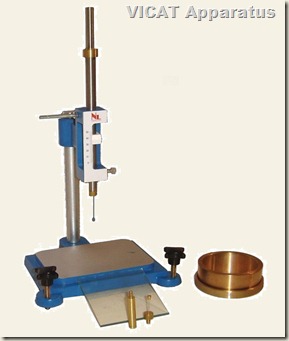
Vicat Appratus
i) VICAT Apparatus.
ii) Digital weighing scale, used to measure the weight of dry cement.
iii) Glass graduates, used to measure the volume of water.
iv) Trowel.
v) Mixing bowl.
vi) Stop-watch.
vii) Portland Pozzolna Cement.
viii) Water.

PROCEDURE
i) Prepare a cement paste by gauging the cement with 0.85 times the water required to give a paste of standard consistency.
ii) Start a stop-watch, the moment water is added to the cement.
iii) Fill the Vicat mould completely with the cement paste gauged as above, the mould resting on a non-porous plate and smooth off the surface of the paste making it level with the top of the mould. The cement block thus prepared in the mould is the test block.

A) INITIAL SETTING TIME
Place the test block under the rod bearing the needle.Lower the needle gently in order to make contact with the surface of the cement paste and release quickly, allowing it to penetrate the test block. Repeat the procedure till the needle fails to pierce the test block to a point 5.0 ± 0.5mm measured from the bottom of the mould.The time period elapsing between the time, water is added to the cement and the time, the needle fails to pierce the test block by 5.0 ± 0.5mm measured from the bottom of the mould, is the initial setting time.

B) FINAL SETTING TIME
Replace the above needle by the one with an annular attachment. The cement should be considered as finally set when, upon applying the needle gently to the surface of the test block, the needle makes an impression therein, while the attachment fails to do so. The period elapsing between the time, water is added to the cement and the time, the needle makes an impression on the surface of the test block, while the attachment fails to do so, is the final setting time.

REPORTING OF RESULTS
The results of the initial and the final setting time should be reported to the nearest five minutes.

CONCLUSION:
To measure the setting times of cement, we have to do our tests on cement of standard consistency. Normal consistency of standard cement can be gained by using the W \ C ratio and depending on 26%- 33%. The higher rate of water the more initial setting time needed.

COMPRESSION TEST

The compressive strength of Concrete is the most common performance measure to determine the strength of concrete for designing.This is measured by breaking cubical of cylindrical concrete specimen in Compression Testing Machine.

AIM
To determine the compressive strength of concrete specimens as per IS: 516 - 1959.

APPARATUS

COMPRESSION TESTING MACHINE i) Compression testing machine conforming to IS: 516 – 1959

AGE AT TEST
Tests should be done at recognized ages of the test specimens, usually being 7 and 28 days. The ages should be calculated from the time of the addition of water to the drying of ingredients.

NUMBER OF SPECIMENS
At least three specimens, preferably from different batches, should be taken for testing at each selected age.

PROCEDURE
i) The specimens, prepared according to IS: 516 - 1959 and stored in water, should be tested immediately on removal from the water and while still in wet condition. Specimens when received dry should be kept in water for 24hrs. before they are taken for testing. The dimensions of the specimens, to the nearest 0.2mm and their weight should be noted before testing.
ii) The bearing surfaces of the compression testing machine should be wiped clean and any loose sand or other material removed from the surfaces of the specimen, which would be in contact with the compression platens.
iii) In the case a of cubical specimen, the specimen should be placed in the machine in such a manner that the load could be applied to the opposite sides of the cubes, not to the top and the bottom. The axis of the specimen should be carefully aligned with the centre of thrust of the spherically seated platen. No packing should be used between the faces of the test specimen and the steel platen of the testing machine. As the spherically seated block is brought to rest on the specimen, the movable portion should be rotated gently by hand so that uniform seating is obtained.
iv) The load should be applied without shock and increased continuously at a rate of approximately 140kg/sq.cm/minute until the resistance of the specimen to the increasing load breaks down and no greater load can be sustained. The maximum load applied to the specimen should then be recorded and the appearance of the concrete and any unusual features in the type of failure should be noted.

CALCULATION
The measured compressive strength of the specimen should be calculated by dividing the maximum load applied to the specimen during the test by the cross - sectional area, calculated from the mean dimensions of the section and should be expressed to the nearest kg/sq.cm. An average of three values should be taken as the representative of the batch, provided the individual variation is not more than ±15% of the average. Otherwise repeat tests should be done.
A correction factor according to the height/diameter ratio of the specimen after capping should be obtained from the curve given below:-

Correction factor for height diameter ratio of core

The product of this correction factor and the measured compressive strength is known as the corrected compressive strength, this being the equivalent strength of a cylinder having a height/diameter ratio of two. The equivalent cube strength of the concrete should be determined by multiplying the corrected cylinder strength by 1.25.

REPORTING OF RESULTS
The following information should be included in the report on each test specimen:
i) Identification mark
ii) Date of test
iii) Age of specimen
iv) Curing conditions, including date of manufacture of specimen
v) Weight of specimen
vi) Dimensions of specimen
vii) Cross-sectional area
viii) Maximum load
ix) Compressive strength
x) Appearance of fractured faces of concrete and type of fracture, if unusual.

WATER ABSORPTION TESTS OF AGGREAGATES

      Water Absorption is the percent of water necessary to add to the aggregate to obtain saturated surface dry (SSD) condition.
This test determines the water absorption of coarse aggregates as per IS: 2386 (Part III) - 1963.
APPARATUS
i) Wire basket - perforated, electroplated or plastic coated with wire hangers for suspending it from the balance
ii) Water-tight container for suspending the basket
iii) Dry soft absorbent cloth - 75cm x 45cm (2 nos.)
iv) Shallow tray of minimum 650 sq.cm area
v) Air-tight container of a capacity similar to the basket
vi) Oven
SAMPLE
A sample not less than 2000g should be used.
PROCEDURE
i) The sample should be thoroughly washed to remove finer particles and dust, drained and then placed in the wire basket and immersed in distilled water at a temperature between 22 and 32oC.
ii) After immersion, the entrapped air should be removed by lifting the basket and allowing it to drop 25 times in 25 seconds. The basket and sample should remain immersed for a period of 24 + ½ hrs. afterwards.
iii) The basket and aggregates should then be removed from the water, allowed to drain for a few minutes, after which the aggregates should be gently emptied from the basket on to one of the dry clothes and gently surface-dried with the cloth, transferring it to a second dry cloth when the first would remove no further moisture. The aggregates should be spread on the second cloth and exposed to the atmosphere away from direct sunlight till it appears to be completely surface-dry. The aggregates should be weighed (Weight 'A').
iv) The aggregates should then be placed in an oven at a temperature of 100 to 110oC for 24hrs. It should then be removed from the oven, cooled and weighed (Weight 'B').
REPORTING OF RESULTS
Water absorption = (A – B)/B x 100%
Two such tests should be done and the individual and mean results should be reported.